Evidence/Artifact #1: ADST Circuit Card Lesson
Understanding that students are on a continuum of learning demonstrates an understanding of student growth and development which is integral to being an effective educator. The goal is to create meaningful lessons that use knowledge of learning differences in students to make informed decisions about curriculum, instruction, assessment, and classroom management.
Using differentiated instruction as part of an Applied Design, Skills, and Technology (ADST) lesson about circuits gave students who struggle with reading and writing the opportunity to demonstrate their understanding in a hands on activity. Using prior knowledge on electricity from what they have learned in science, students were able to create cards that used conductive tape, LEDs, and batteries and were able to light up. Students were required to create a card that made a circuit that would light 1-2 LEDs. Using the ADST curriculum to explore the concepts of design, prototyping, construction, and review all students were able to create as basic or elaborate cards as they wanted. The only requirements was the card needed a working circuit and light up at least 1 LED.
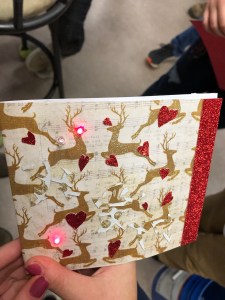
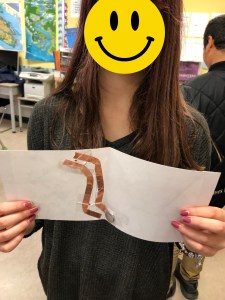

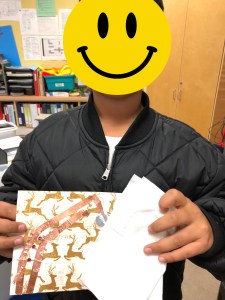
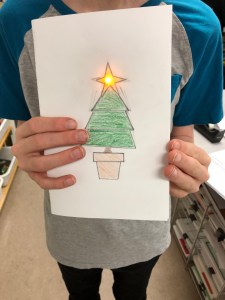
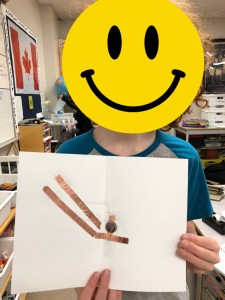
Once students had completed their circuit cards they were required to also complete a self assessment. Students were each given feedback that celebrated their successes, empathized with their frustrations, and gave direction for the future.
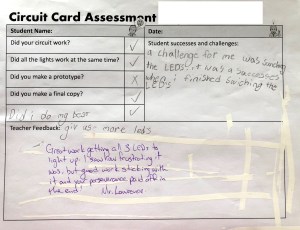

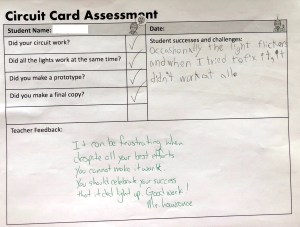
What I learned and Why is it important
This hands on activity gave all students the ability to demonstrate their understanding of the how circuits work. Giving students a choice to how many LEDs they wished to use let those who wanted to challenge themselves the opportunity to do so while at the same time gave those who could or only wanted to accomplish what was expected that choice. Many chose to use more than what was expected which was what I was hoping, but a few only wanted to use one.
Using a self-assessment was a valuable learning tool in the assessment process. It gave students the ability to track their own progress, identify if they had met all the criteria outlined at the start of the lesson, revise their work if need be, and help identify their own skill gaps or where there knowledge needs improvement. I found the process to be beneficial to the students when paired with teacher feedback. When a new ADST activity was introduced I had students review the feedback to identify successes and improvements which could be used to influence thinking moving forward.
References
BC Ministry of Education. (2020). Applied Design, Skills, and Technologies. Retrieved from https://curriculum.gov.bc.ca/curriculum/adst
BC Teachers’ Council. (2019, June 19). Professional Standards for BC Educators. Retrieved from https://www2.gov.bc.ca/assets/gov/education/kindergarten-to-grade-12/teach/teacher-regulation/standards-for-educators/edu_standards.pdf
bee-a-maker. (n.d.). DIY Paper Circuit Card. Retrieved from https://www.instructables.com/id/Design-a-Basic-Circuit/
Lawrence, Devon. (2019). Circuit Card Assessment.
Evidence/Artifact #2: Inclusion
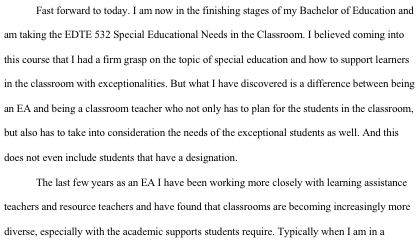
For many years before entering the teacher education program at Vancouver Island University I worked as an Education Assistant with School District 79 and a Community Support Worker with Clements Centre Society working with youth with special needs. Inclusion has always been a focus for me when supporting any youth with special needs as I have found many can mistake integration with inclusion. In my EDTE 532 Special Education course we were required to compose a final reflection paper on our commitment to inclusion. In this paper I outlined my experiences with the evolution of inclusion as I have seen it over the past 25 years working with youth with special needs. It has always been my goal to ensure students with special needs take part in the same opportunities as their peers either in school or in the community. I have been fortunate to learn from some of the pioneers in inclusion during my time in special education.
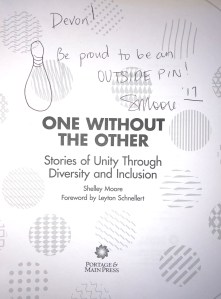
One such pioneer I have had the fortune to meet various times before, during, and most likely after my time in the teacher program is Shelley Moore. I have learned from to her at conferences, various workshops and provincial learning community days, and now with her partnership with the BC Ministry of Education’s video series 5 Moore Minutes. She outlines in her 5 minute videos the goal is “empowering schools and classrooms to support ALL Learners!” (Moore, 2019) This is where I am today. Over the years I have created academic supports for students with special needs so they too can be included many academic classes; mostly math and science. These supports were so effective that they started to be offered to any student who felt they needed the support. My idea to support those who need it the most had the ripple effect of supporting all in the class if they felt they needed the support.
What I learned and Why is it important
Since teachers are expected to understand and apply knowledge of student growth and development, inclusion is key. Teachers must show an understanding of individual learning differences and special needs as this will help guide them in making decisions about curriculum, instruction, assessment, and classroom management. Working in classrooms and in the community with youth of varying abilities I feel I have experienced and truly understand learning differences and special needs. It is my experience that drove me to enter the teacher education program as I will be able to bring my evolving understanding to inclusion to the classroom in a new role as a teacher. I want to be able to make decisions about curriculum, instruction, assessment and classroom management, so that all my future students may have inclusive learning experiences.
References
BC Teachers’ Council. (2019, June 19). Professional Standards for BC Educators. Retrieved from https://www2.gov.bc.ca/assets/gov/education/kindergarten-to-grade-12/teach/teacher-regulation/standards-for-educators/edu_standards.pdf
Moore, S. (2016). One without the other: stories of unity through diversity and inclusion. Winnipeg, MB, Canada: Portage & Main Press.
Moore, S. (2020). 5 Moore Minutes: With Shelley Moore. Retrieved from https://fivemooreminutes.com/
Lawrence, Devon. (2020, March, 20). Final Reflection: EDTE 532. Vancouver Island University. Duncan, BC, Canada.
 mrdevonlawrence.com