Evidence/Artifact #1: Let’s Go Shopping!
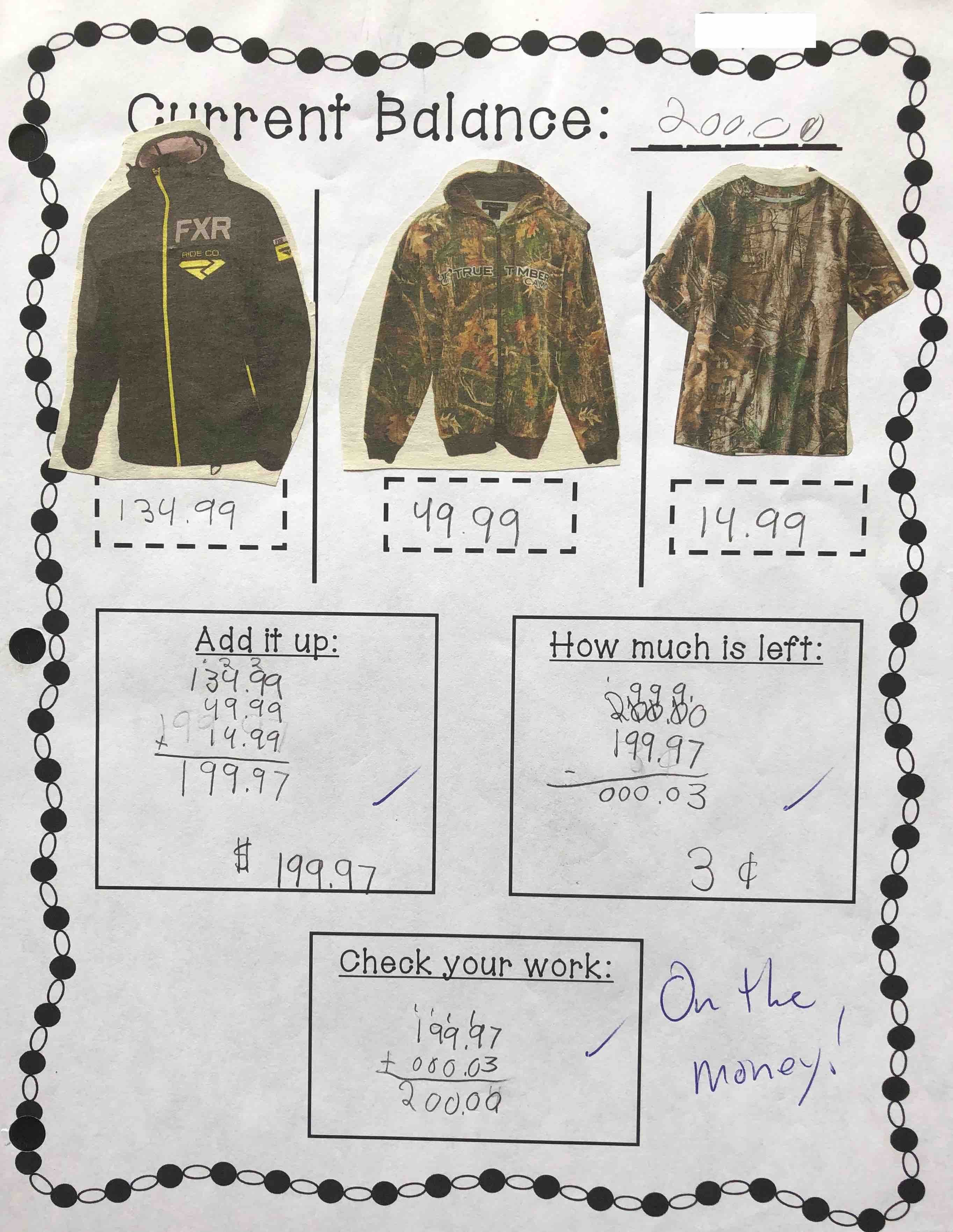
During my spring practicum at Drinkwater Elementary School, I was asked by my mentor teacher if I would cover the topic of decimals with the class. My class was a combined grade 6/7 and I planned on teaching the concepts of addition, subtraction, multiplication, and division of decimals adjusting for grade and the ability of each individual student. Mathematics can be uninteresting and a struggle for students to grasp the concepts. My plan was to bring in real world applications to help reinforce the concepts.
I decided to use shopping in one of my activities to better connect the concept of addition and subtraction of decimals. By the age of 12-13, most students have had exposure to shopping both with their parents/family and individually. I found an activity online that used the shopping model, but I needed to modify it to provide a better connection to the assignment in addition to providing an assessment criteria.
Students were provided with a copy of the assignment and access to flyers for local stores where they could find clothing and cut out the items they wished to purchase. The students could work together or individually on the assignment, but most wanted to work with their friends.
click to enlarge
What I learned and Why is it important
I found there to be an unexpected result of the assignment which was the students wanted to round the decimals to the nearest tenth as most of the items they were selecting were either 97 or 99 cents to the dollar. Their rationale was that in Canada we no longer use a penny and many transactions when paying with cash round up or down depending on the price. Even though this was correct and creative, I readdressed the class to inform them that I would not like them to round the decimal as if they are paying with a debit card it calculates to the penny.
In the future, I now know I should be very accurate with my expectations and outline for each assignment I provide for the students.
References
BC Teachers’ Council. (2019, June 19). Professional Standards for BC Educators. Retrieved from https://www2.gov.bc.ca/assets/gov/education/kindergarten-to-grade-12/teach/teacher-regulation/standards-for-educators/edu_standards.pdf
Teaching with a Mountain View. (2019). Adding and Subtracting Decimals Math Project. Retrieved from https://www.teacherspayteachers.com/Product/Adding-and-Subtracting-Decimals-Math-Project-81104
Evidence/Artifact #2: Two Class PE Lesson
It is important to be well planned for a PE lesson in the gym. During my fifth year practicum, my grade 7 class was a middle school model where two classes went back and forth between two teachers, so in essence I had 44 students. On Tuesday our classes would join in the larger gym for a combined class and I offered to teach a new game without the assistance of the two teachers and another pre-service teacher. With double the regular amount of students I would usually teach for one class I needed to ensure I was well organized in my planning, instruction, and classroom management.
I choose a game called Mat Ball from ThePhysicalEducator.com where the focus skills are on creating space, passing and receiving, and reducing space. I also felt this game would be well suited for the size of the group. The game offered scaffolding, called ‘builds’, as it can take time to learn all the rules of a new game which can cause confusion for students. A quick set of rules were explained to the students and the game was started. The focus of the first build is to work on the fundamentals of passing and receiving. As the students developed an understanding and sense of mastery of the beginning game elements it became increasingly more complex by the addition of more elements.
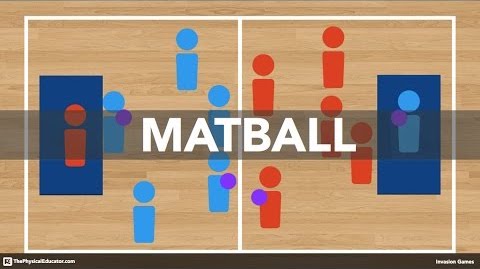
The games are new to all students which makes them exciting. The builds also take into account the students’ learning and development as the game does not progress to a new build until there is a sense of mastery with all students. Once there is mastery in the fundamental skills of the game, strategy is introduced and the full game is played. Typically the full game is not explored in the first lesson.
What I learned and Why is it important
My goal in physical education is to be able to teach the same skills that would be taught in traditional PE games such as basketball, volleyball, soccer, etc., but in a different format. I have found that when the same units are taught in PE year after year there is no room for creativity or flexibility. Introducing new options in the PE curriculum provides students with a inclusive environment as everyone is learning new games while developing skills that are transferable across all gameplay.
References
BC Teachers’ Council. (2019, June 19). Professional Standards for BC Educators. Retrieved from https://www2.gov.bc.ca/assets/gov/education/kindergarten-to-grade-12/teach/teacher-regulation/standards-for-educators/edu_standards.pdf
Feith, Joey. (n.d.). Matball. The Physical Educator. Retrieved from https://thephysicaleducator.com/game/matball/
Evidence/Artifact #3: Mock Report Cards
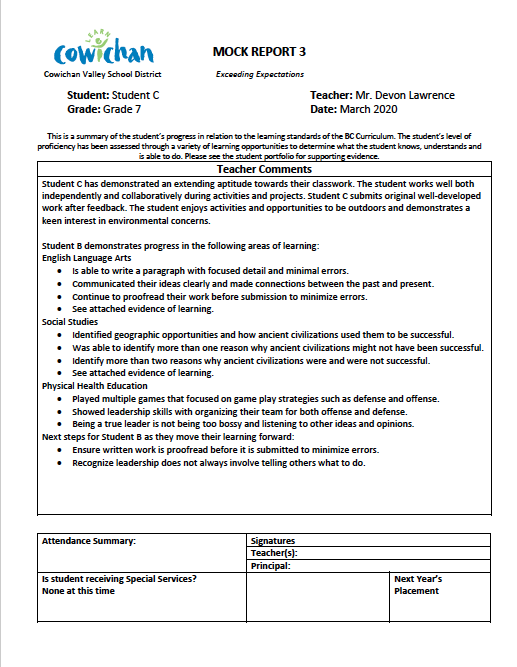
Three mock report cards were created to display the different abilities of students. Using the BC Curriculum’s proficiency scale to measure achievement the first report is a student who displays a partial understanding (developing), the second report is a student who displays a complete understanding (proficient), and the third report is a student who displays a sophisticated understanding (extending). This evidence directly links to the standard and is important to showcase my understanding of student assessment including reporting practices.
Developing 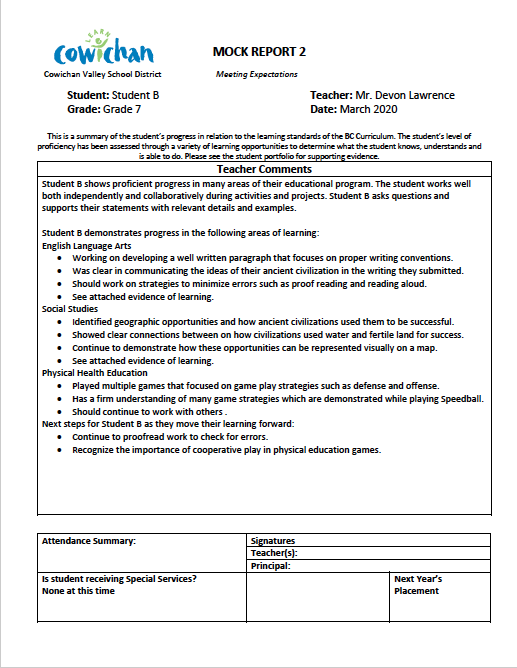
Proficient 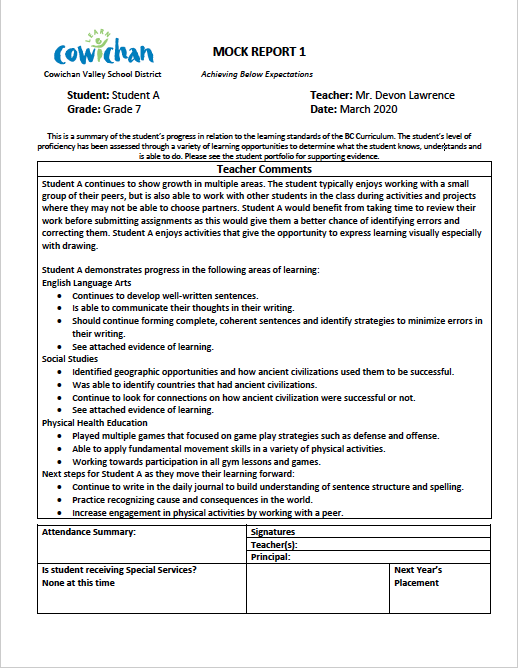
Extending
Included in each report:
- Mock Report Card
- Writing Assessment
- Writing Sample
- Curricular Competency Assessment
- Curricular Assignment Sample
| MOCK REPORT 1 | MOCK REPORT 2 | MOCK REPORT 3 |
What I learned and Why is it important
Completing mock report cards gave me a better understanding of how to communicate student learning to both parents and students. Writing report cards can be challenging as it can be easy to only point out students weaknesses, but when assessing student work from a strength based and positive lens there is a better chance of the information being understood and there to be growth from learners. I found it important to be clear and concise to convey positive constructive information in a way that is not full of teacher jargon that parents and students will have a difficult time understanding.
References
BC Teachers’ Council. (2019, June 19). Professional Standards for BC Educators. Retrieved from https://www2.gov.bc.ca/assets/gov/education/kindergarten-to-grade-12/teach/teacher-regulation/standards-for-educators/edu_standards.pdf
n.d. (2018, December). Paper-Portfolio-sample-writing. Communicating Student Learning: Points of Progress Learning Samples. Retrieved from http://csl.sd79.bc.ca/wp-content/uploads/sites/148/2020/01/Paper-Portfolio-sample-writing.docx
Lawrence, Devon. (2020, March). Curricular Competency Assessment.
Ready, Rich. (2019, January). Primary January. Communication Student Learning: Summary of Learning (Report Card) Samples. Retrieved From http://csl.sd79.bc.ca/wp-content/uploads/sites/148/2019/12/Primary-January.pdf
 mrdevonlawrence.com