
Clear Learning Intentions: let students know (in a language they can understand) what they are expected to learn.
This is very important! Teachers should be clear with students what is expected of them and what the learning intentions are if success is the goal. In my experience there is little student engagement or involvement when the student is not clear on what they are doing and why they are doing it. There is a time and place for learning to be spontaneous and without structure, but even then teaching students how to handle situations that are unpredictable sets them up for success. They will learn how to expect the unexpected as well as to be able to handle a task when there sometimes is not clear direction or meaning to what is required.
Criteria: work WITH learners to develop criteria of what quality looks like.
When working with students I have found that it works best if you are able to take what the BIG IDEAS and CONENT from the curriculum and work with the students to develop the criteria for what quality looks like. During the Slam Poetry unit that I co-taught my teaching partner and I created a video of what we thought a developing and proficient video looks like. We then worked with the students to refine what they felt would constitute a developing and proficient video.
Descriptive Feedback: increase descriptive feedback (ongoing dialogue around improvement in learning that causes thinking) and decrease evaluative feedback (numbers, letters, and “good job”).
Descriptive feedback is key. Little is learned when you give a student back an assignment with just a mark on it whether it be a letter or numerical grade. I find myself that I crave descriptive feedback as I have a difficult time understanding how I have really done on an assignment. During the slam poetry unit each student in my class was required to complete a graphic organizer. Once the unit was complete and handed in I provided detailed descriptive feedback that was unique to each student. I felt it was the best way for each student to learn and improve moving forward.
Powerful Questions: increase quality “thinking” questioning to go deeper and show evidence of learning.
“What is your job?” This sounds like a basic question that many younger students might ask someone that they meet. It is to the point and does garner information, but is not what I feel would constitute a ‘powerful question’. This type of question would be what I would expect to receive from a primary student. As students learn the expectations is that their thinking evolves so that their questioning becomes more powerful. The hope is that a student can evolve “What is your job?” into “How did you decide that you wanted to do that job?” When students begin to ask powerful questions they begin to receive powerful answers.
Self and Peer Assessment: Scaffolding of learning of self and peer assessment in a supportive, collaborative environment enables learners to become thoughtful about all aspects of their learning.
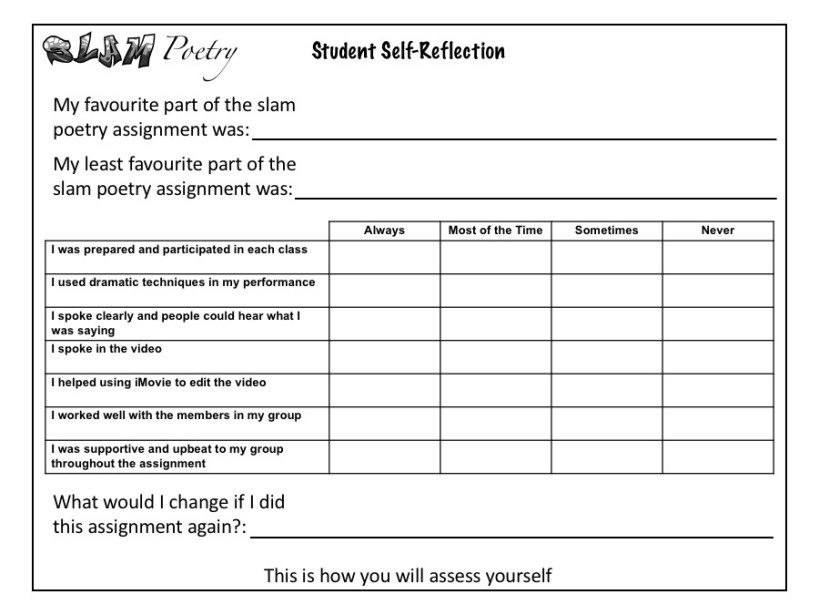
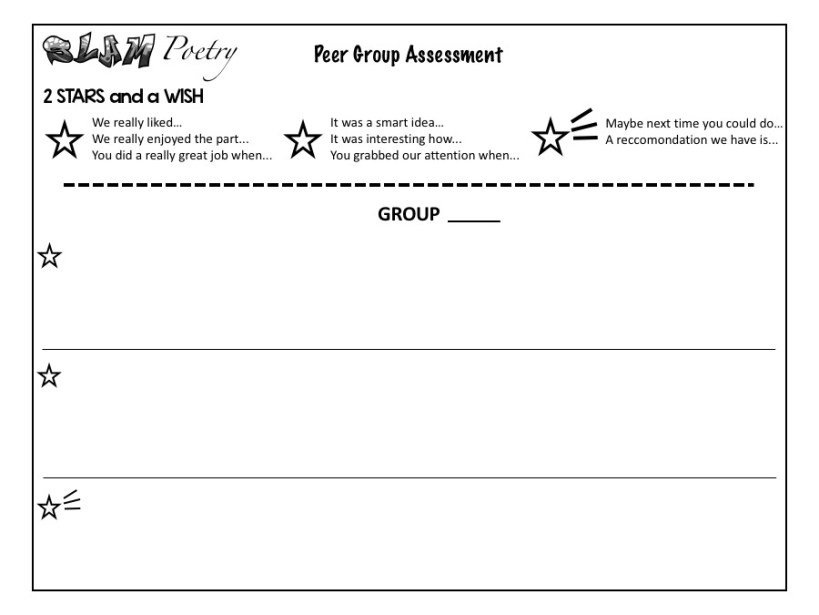
Dr. Heidi Andrade wrote, “If students produce it, they can assess it; and if they assess it, they can improve it.” This is a very powerful statement that I found myself incorporating in my Slam Poetry unit that I recently taught that had students record a video of themselves speaking spoken word poetry. In a graphic organizer I created I included not only a self assessment, but also a peer assessment. My thinking was exactly what Dr. Andrade spoke that the students were creating a video that they needed to assess both individually and by peers, and in doing so would be able to improve moving forward on other assignments with the feedback.
Student Ownership: centres on metacognitive awareness and action. Metacognition is enhanced only when students have explicit understandings related to all other aspects of AFL – and are able to take ownership for their learning as a result.
Creating an environment where students have ownership of their learning can only serve to enhance what they learn.

 mrdevonlawrence.com