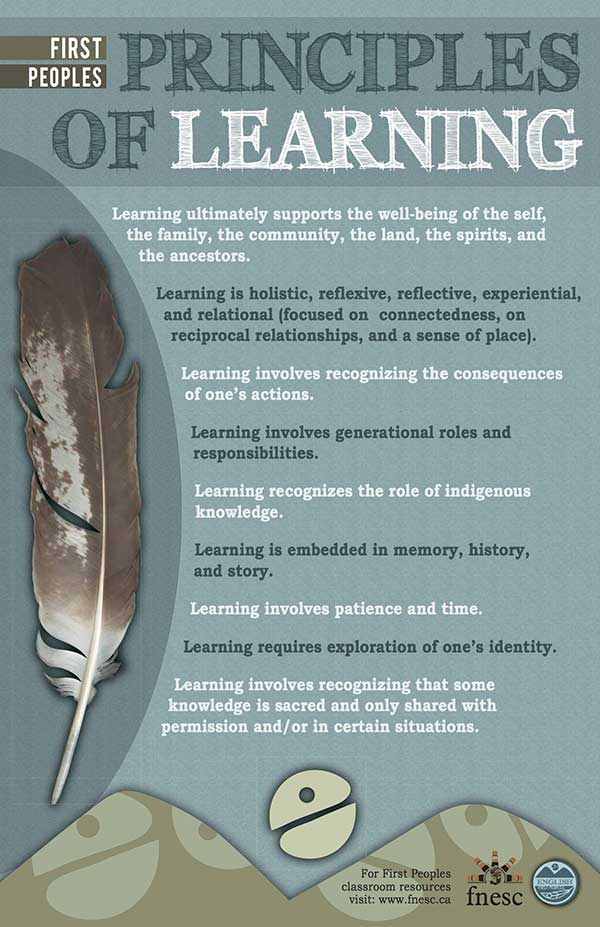
Learning ultimately supports the well-being of the self, the family, the community, the land, the spirits, and the ancestors.
Learning never stops and is a lifelong process. This process impacts everyone and everything around us. I can see this in almost every situation that I encounter in my life, but where it really is focused is in classrooms with students. The students I have had the opportunity to work with over the years and in my practicum have diverse backgrounds and many influences on who they are and where they are going not only as a student, but as an individual and a life long learner.
Learning is holistic, reflexive, reflective, experiential, and relational (focused on connectedness, on reciprocal relationships, and a sense of place).
Since learning happens all the time students are constantly experimenting and generating ideas. In doing so education can reveal itself in many ways and they are all usually connected in some way. This is seen as holistic education. In doing so learning can build upon itself and grows exponentially to develop deeper understanding and how things are connected. Learning also does not happen without reflection and with reflection comes making sense of new experiences and to use them to make new connections to what is already know.
Learning involves recognizing the consequences of one’s actions.
Taking responsibility for one’s own actions is and that all actions have consequences. It is important that students understand how their action can not only effect the people around them, but their family, ancestors, and even environment.
Learning involves generational roles and responsibilities.
Teaching and learning is the responsibility of all members of the community. As students develop their skills and knowledge they will pass it on to others. The responsibility for learning also lies with the learner. It is the responsibility of the learner to determine what he or she is supposed to learn from any given situation.
Learning recognizes the role of indigenous knowledge.
Indigenous peoples hold an extensive wealth of knowledge. Having elders and cultural support teachers come into the classroom and share their knowledge is a great way to pass on knowledge. Knowledge that is typically oral as that is the thousands of years old. Taking students to indigenous cultural locations as well is another way students can absorb and learn indigenous knowledge.
Learning is embedded in memory, history, and story.
Stories have been used for as long as people have been on earth to pass on knowledge and facilitate learning. Classrooms are social and as such students talk with each other and pass along their knowledge by telling stories with each other. Stories can be a powerful tool and used to decimate knowledge to one or many.
Learning involves patience and time.
Student learning is a process that cannot be rushed. Many teachers that I have observed are very diverse in their instruction to accommodate students learning and I myself have also worked with many students in these classrooms at different speeds. There is an understanding that individuals all learn at their own pace and students are no exception. Learning cannot be rushed for true understanding.
Learning requires exploration of one’s identity.
The exploration and creation of a students’ identity is key in the role of their development. As a parents and educator I have seen first hand how powerful this process can be for the child. Identity is what can connect students to one another, to their community, and the land.
Learning involves recognizing that some knowledge is sacred and only shared with permission and/or in certain situations.
Whether or not knowledge is shared depends on the type of knowledge, who holds that knowledge, and the context. Some knowledge is freely shared, while other knowledge is not. This can be a developing process for many students as with use of digital technologies knowing what information can be shared can be difficult. Learning what knowledge can be shared and what cannot is a powerful tool for students.
To discover more about the First Peoples’ Principles of Learning please explore http://www.fnesc.ca/

References
First Nations Education Steering Committee. (2015). First Peoples Principals of Learning. [Infographic]. Retrieved from http://www.fnesc.ca/wp/wp-content/uploads/2015/09/PUB-LFP-POSTER-Principles-of-Learning-First-Peoples-poster-11×17.pdf
 mrdevonlawrence.com